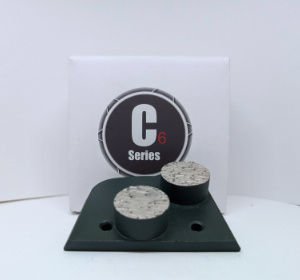
Metal bond
The grinding stage: flatten, open the slab and remove thin coatings.
Metal bond, hybrid transition, resin and phenolic polishing pads, and DIP maintenance pads — in stock in Kalamazoo, with a team that runs this tooling and can help you pick the sequence.
A typical full sequence, start to finish. Harder slabs or lighter exposure can skip steps; coatings or soft concrete can add one. Stop at the step that meets your gloss spec.
Metal-bond diamonds open the slab, take off coatings and set the flatness and exposure you'll live with. The bond is matched to the concrete: soft bond for hard slabs, hard bond for soft or abrasive slabs.
Tell us: machine and plate · slab hardness · what's on the floor now
A guide, not a universal recipe. The right sequence depends on your slab, your machine and the finish you've been asked for.
Inland Diamond tooling for concrete grinding and polishing. Tell us what you're running and what the job needs — we'll confirm fit, availability and pricing.
The grinding stage: flatten, open the slab and remove thin coatings.
Hybrid tools that clear the metal scratch before resin.
Polishing pads that build clarity step by step to your gloss spec.
Coating and mastic removal, edges and texture work.
Corners, edges, stairs and small areas the big machine can't reach.
Diamond-impregnated pads that keep a polished floor looking polished.
Send the make, model and a photo of the plate or your current tools — we'll confirm fit before you order.
The right question isn't just "what grit?" Give us three things and we'll come back with tooling, pricing and availability:
They're the Concrete Polishing Council's aggregate-exposure classes:
How deep you cut depends on how the slab was placed and finished, so the only reliable answer is a test area on the actual slab. Cream removes the least material but leaves the least room for error. Full aggregate takes the most metal-bond work.
The CPC appearance chart describes four levels. Rough rule of thumb for where each one lands:
Levels are judged by reflective clarity (measured with a DOI meter) and haze, not grit alone — the same grit reads differently on different slabs.
A grout coat fills pinholes, surface voids and small cracks so the polished floor reads as one continuous surface. It goes down during the grind and is ground back flush on the next step.
HTS TX-3 is a 1:1, 100%-solids urethane repair material. Use it neat, or mix in sand or your own grinding dust for a color-matched repair, on grout coats, cracks, spalls and joints. Once it's hard — roughly 45 minutes, depending on temperature — grind it with the next step. It's a repair material, not a densifier; follow the HTS data sheet for your conditions.
Match the tool to what's on the floor. Thick coatings (epoxy, urethane) and heavy mastic: PCD tools — they shear the material instead of grinding it, so they don't clog. Thin coatings and sealers: aggressive metal bond, starting at 16/20 or 30/40. Soft, gummy adhesives: scrape the bulk off first, then grind.
Keep the RPM down so adhesive doesn't heat up and smear. We rent scrapers and grinders if you need the machine.
Not until it's tested. Under OSHA's asbestos rules, asphalt and vinyl flooring installed in 1980 or earlier is treated as asbestos-containing until testing proves otherwise, and old black cutback adhesive often contains asbestos too.
Have it sampled by an accredited lab before any grinding, scraping or shot blasting. If it's positive, it's a job for a licensed abatement contractor — not a grinder.
A typical full sequence: metal bond 30/40 → 60/80 → 100/120 (start at 16/20 on very hard slabs, heavy coatings or deeper exposure); hybrid transition 50 → 100; then resin and phenolic 200 → 400 → 800 → 1500 → 3000+ Luxe. White resin is available from 200 grit up.
Harder slabs, lighter exposure or an already-smooth surface can skip steps; soft slabs or coatings can add one. Densifier usually goes down around the 200 step, and a guard and burnish finish the job. Stop at the step that meets your gloss spec.
It's the opposite of what most people expect: hard concrete needs a soft bond, and soft concrete needs a hard bond. A soft bond wears just enough to keep exposing fresh diamond on dense concrete; a hard bond holds up on soft or abrasive concrete.
If your tools stop cutting and look shiny — glazed — the bond is too hard for the slab. If they're disappearing fast, it's too soft. Tell us what you're seeing and we'll adjust.
Wet grinding gives better refinement and faster cutting, but it requires slurry management and disposal. Dry grinding is much easier and needs less equipment. Tell us which you run so we match the pads.
We carry tooling for Lavina, Husqvarna, HTC, National Flooring Equipment, SASE, Bartell, Newgrind, Scanmaskin and STI machines. Send the make, model and a photo of the plate or your current tools, and we'll confirm fit before you order.
Both. Common tooling is in stock at 414 Mills St in Kalamazoo — pick up Monday to Friday, 8 to 5. We also ship; freight is quoted with your order.